UG Calculator – Is Your Dino Trade Fair?
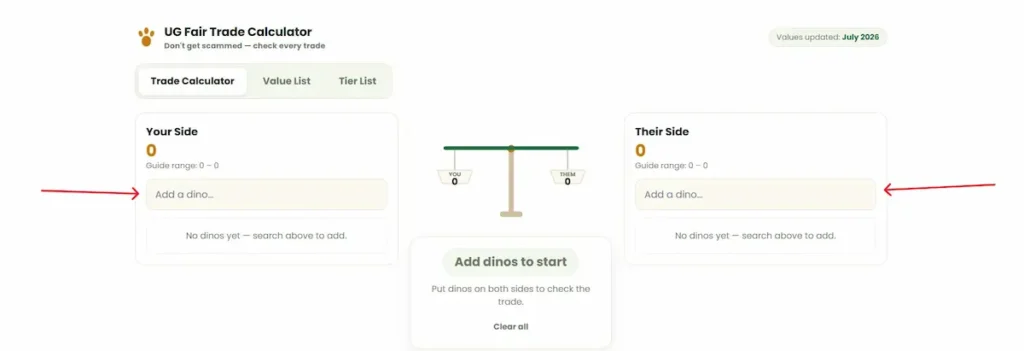
The UG Calculator tells you in seconds whether a dino trade is fair. Add the dinos on each side, set their levels, and mark any that are Mothers, Bundles, or still Eggs. The tool compares both sides and gives you a clear result: Fair, Acceptable, Unfair, or Very Unfair. That way you know if you’re getting a good deal or getting scammed before you agree to anything. It’s free, works on your Quest or your phone, and covers every dino currently in UG.
Your Side
Their Side
How to check if a UG trade is fair
Checking a trade takes about ten seconds. Here’s how it works:
- Add your dinos. Search for each dino you’re giving away and add it to your side.
- Add their dinos. Do the same for everything you’d get back in return.
- Set the details. For each dino, set its level and tap M (Mother), B (Bundle), or Egg if any of those apply. These change how much a dino is worth.
- Read the result. The calculator gives a fairness verdict and points out which side is worth more, so you can accept, counter, or walk away.
If one side is worth far more than the other, you’ll see it right away. No guessing, and no taking a stranger’s word for it.
What your trade result means
Every trade lands on one of four results. Here’s what each one actually means for you:
| Result | What it tells you |
|---|---|
| Fair | Both sides are worth about the same. A safe, even trade. |
| Acceptable | Slightly uneven, but close enough that neither side really loses out. |
| Unfair | One side is clearly worth more, so someone would be overpaying. |
| Very Unfair | A big gap between the two sides. Often a sign the lower side is being scammed, so think twice. |
The verdict comes from the total guide value of each side, so adding, removing, or leveling up a single dino can flip the result. If a trade comes back Unfair, try countering with a different dino before you give up on it.
How UG dino values are decided
UG has no official trade prices. Every value here is a guide value, based on how players actually trade in the game: which dinos people want, how rare they are, and what they swap for in real deals.
A few things push a dino’s worth up or down:
- Rarity and demand. Dinos that are hard to get, or that everyone wants right now, trade higher.
- Level. A higher-level dino is usually worth more than a low-level one of the same type.
- Mother (M) and Bundle (B). Mothers and bundles add value on top of the base dino.
- Egg state. An unhatched egg is worth less than a hatched, raised dino.
Values also shift over time. A brand-new dino is often overpriced during the first rush, then settles once more players own one. Because of that, these values are updated regularly to reflect how UG is trading now, not how it traded months ago. Treat them as a trusted guide to help you trade with confidence, not a fixed price set by the game.
UG dino value list
You can look up any dino in the Value List tab above. It shows every dino currently in UG, with its category and its base stats: health, damage, and speed. That way you can see how strong a dino is, not only what it’s worth.
Some dinos sit well above the rest. Titans such as Triskeletops, Ballrug, and Cryodon are among the rarest and most wanted in the game, which is why they hold the highest trade values. Starter and common dinos sit near the bottom. Keep in mind that the value shown is a base guide, and the real number moves with the dino’s level and whether it’s a Mother, Bundle, or Egg.
UG dino tier list
The Tier List tab ranks every dino from S down to D by trade value, so you can see where each one stands without comparing numbers yourself.
- S tier: the rarest, highest-value dinos, and the ones most players are chasing.
- A and B tiers: strong, desirable dinos that hold solid value.
- C and D tiers: common and starter dinos that are easy to get and trade cheaply.
Hand-made tier lists go out of date the moment a new dino drops. This one rebuilds itself from the current values, so it stays accurate as UG keeps changing.
UG dino types (categories) explained
UG dinos fall into a handful of types, and each one trades differently because of what it’s built to do.
- Hunters are small, fast, and agile, with low damage. Raptoe and Dilophosugus are among the quickest in the game, which makes hunters better for getting around than for fighting.
- Tanks are built around size and health. They deal steady damage and stay reasonably quick, so they hold up well as dependable all-rounders.
- Titans and Super Titans are the heavy hitters, with huge health and damage but very little speed. Their power and rarity make them some of the most valuable dinos you can trade.
- Gliders and Flying Titans are fast fliers that travel long distances and hit hard with a dive attack, though they bruise easily. Flying Titans give up some of that speed for extra size.
- Hydro is the newest type, built for water, with dinos like Spinosugus and Hammerhug. Because the category is recent, their trade values are still settling.
- Hybrids are two dinos fused into one, usually a mix of a tank and a hunter. Beastasaur and Spinosugus, for example, fuse into the Spinybeast. Since they take real effort to make, hybrids tend to hold strong value.
- Bundles are special packaged versions that are rarer than the standard dino, which is why marking a Bundle (B) raises its worth in a trade.
Knowing a dino’s type helps you judge a trade faster, since rarity and demand usually follow what each type can do.
How to avoid getting scammed in UG trades
Most scams in UG work the same way: someone makes a trade look better than it is, or rushes you before you get a chance to check. A few simple habits keep you safe.
- Check both sides first. Run every trade through the calculator before you accept. “Trust me, it’s fair” is not proof.
- Watch out for brand-new dinos. A new dino’s value spikes during the first rush, then drops quickly once more players own one. If someone is pushing a new dino hard, check today’s value, not last week’s.
- Read the details, not just the name. Level, Mother, and Bundle change a dino’s worth a lot. A low-level, standard dino is not the same as a maxed Mother with the same name.
- Screenshot before you accept. If a dino gets swapped at the last second or a deal goes wrong, you’ll have proof of what was agreed.
- Never trade under pressure. Rushing you is a scammer’s favorite trick. If someone hurries you, or the offer looks too good to be true, walk away. A fair trader will always wait.
Trade slow, check twice, and you’ll keep the dinos you worked hard for.
Frequently asked questions
Is the UG calculator official?
No. It’s an unofficial, fan-made tool and isn’t affiliated with UG VR. The values come from the trading community, not from the game itself.
How are dino values calculated?
Each value is a community guide based on real trading. A dino’s rarity, demand, level, and whether it’s a Mother, Bundle, or Egg all shape how much it’s worth.
How often are values updated?
Regularly. As new dinos are added and trading habits change, the values are refreshed so they reflect how UG is trading now instead of months ago.
What do M, B, and Egg mean?
M marks a Mother, B marks a Bundle, and Egg means the dino is still unhatched. Mothers and Bundles add value, while an Egg is worth less than a hatched, raised dino.
Why did a dino’s value go down?
Usually because it got easier to get, or the early hype faded. New dinos in particular lose value once more players own one.
What’s the most valuable dino in UG?
The rarest Titans, such as Triskeletops, Ballrug, and Cryodon, sit at the top, though the exact order shifts with demand. Open the Value List for the current ranking.
Does level change a dino’s value?
Yes. A higher-level dino is generally worth more than a low-level one of the same type, which is why you set a level for every dino you add.
Can I use this on Quest or my phone?
Yes. It runs in any browser, so you can open it on your Quest, phone, tablet, or computer with nothing to download.
UG Fair Trade Calculator (ugcalc.com) is an unofficial, fan-made tool and is not affiliated with UG VR or its developers. All values are community-based guides to help you trade fairly and may differ from your own view of a dino’s worth.